Discovery of Machu Picchu
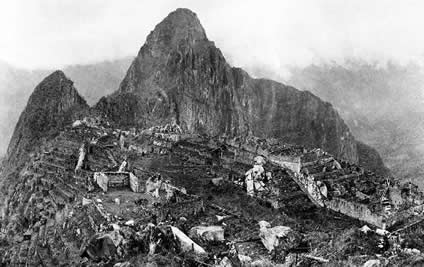 The international community of archaeologists has attributed the discovery of the Citadel of Machu Picchu American expeditionary and Dean of the history department at Yale University, Hiram Bingham, also recognized as a famed anthropologist, who started to study archaeology just as a hobby. Hence, on July 24, 1911 is designed to be the day of the archaeological discovery of the Citadel of Machu Picchu by Hiram Bingham, although still being debated if you have to attribute such an honor since, the archeology remains are several inscriptions dating from the 14 July 1901 where can be seen clearly recorded in the ruins of these names to other visitors whose names are Enrique Palma, Gabino Sánchez and Agustín Lizárraga.
However, neither the discovery by the expeditionary Hiram Bingham in the year 1911 nor the proof that Enrique Palma, Gabino Sánchez and Agustín Lizárraga left record after passing through the Machu Picchu in 1901, have been able to prove with certainty that the true discovery of the Machu Picchu Inca Citadel has granted to the local indigenous population that through agricultural expansion caused by the exploitation of holdings throughout the system of mountain ranges, came to repopulate this geographical area situated on the slopes of the Vilcanota mountain range just 80 kilometers from the city of Cuzco.
The Chronicles dating from year 1901 on the stay of Enrique Palma, Gabino Sánchez and Agustín Lizárraga in the Citadel of Machu Picchu, recount the presence of indigenous regional population, such as the peasant and indigenous farmer Anacleto Alvarez, which claimed to have working the land in the vicinity of the Citadel of Machu Picchu for more than eight years, during which had been residing in the vicinity of the city while conducting work on Agriculture and animal husbandry in the area. In these stories, expresses the fact that the local indigenous population had been using the land for the farm for decades and, ironically, did not give much importance to the existence of ruins of past civilizations due to the abundance of archaeological remains by the mountain range of the Vilcanota.
The Citadel of Machu Picchu belongs to areas that are part of the ancient states of Qollapani and Kutija. Due to its complicated network system through mountains and deep valleys, the topographic works on these lands were so inaccurate and difficult to proceed with that many of these lands were abandoned, although they were still part of the properties of several landowners, properties that were used by the local indigenous population as settlements. That is the reason why this city never was as important for the world as it is now during these days. The Citadel of Machu Picchu has a great meaning and value as part of the historical and cultural world heritage granted by United Nations Educational, Scientific and Cultural Organization (UNESCO) in 1983.
Since Hiram Bingham based this expedition in his passion for archaeology, it is not strange to conclude that this discovery was fundamentally just a coincidence because Hiram Bingham went on board to search for the city of Vitco, not for the Citadel of Machu Picchu. The city of Vitco has a very important meaning, historically speaking, and it has been known as the last location for the Inca civilization when seeking refuge from the invasion of the conquerors of the Spanish Crown's Empire. After a long period of tedious research and several years of failed expeditions in the whole area, the native population, in addition to its great knowledge of the area, helped Hiram Bingham to gather enough information to get to the city of Vitco. However, Hiram Bingham did not think about the fact that the local native communities relate such historical events with the exact location where occurred because, for these native indigenous communities, the ruins had been ever-present all over the Vilcanota mountain system.
For this reason, it is not strange to think that the Spanish conquerors refer to Machu Picchu the lost city. The mystery that surrounds this citadel relies on the story tales described by the conquerors, who mentioned that, according to different indigenous legends, Machu Picchu held innumerable wealth owned by the Inca Emperor, who also possessed a holy cortege with 100 virgin women, chosen among the most beautiful women from the Inca high aristocracy. All this led the conqueror Francisco Pizarro, followed later by a series of Spanish explorers, to continue with the work of tracking in the area, in order to give the famous sacred Temple and, at the same time, lost city of the great Inca civilization.Therefore, the Citadel of Machu Picchu is, without doubt, one of the most important archaeology discoveries of the last century and is, as today, the most relevant tourist center of the country as well as one of the largest centers who holds archaeological ruins of such countless historical and cultural value.

